How to Read a Yarn Label: Symbols, Yardage, and Care Codes Explained
A yarn label is the most useful piece of paper in your project bag, and it is easy to ignore when a color has your attention. Those small lines and icons answer the questions that decide whether a sweater fits, whether a baby blanket survives the wash, and whether the second skein matches the first. Reading a label takes about a minute. It can save you hours of ripping back.
Here is what each part means, which details matter when you are buying, and how to use the label once the knitting is done.
Start with the numbers: weight, yardage, and put-up
The big print usually tells you the skein’s mass and length: something like 100 g / 3.5 oz, 220 m / 240 yd. The weight in grams tells you how much yarn you are buying by mass. The yardage or meterage tells you how far it will go. Those are not the same thing.
A dense cotton and an airy wool blend can both weigh 100 g, but the cotton may hold 180 m while the wool blend holds 300 m. That is why comparing “100 g skeins” is not enough when you substitute yarn. Compare meters or yards, then check gauge.
You will also see the put-up: skein, ball, hank, or cake. A hank is usually a large loop that needs winding before you knit; a cake or ball is ready to use. If you buy a hank online, plan to wind it on a swift and ball winder, or carefully by hand.
Many labels include a yarn-weight number inside a skein icon, from 0 (lace) to 7 (jumbo). In Europe you are more likely to see names: lace, fingering, sport, DK, worsted, aran, bulky. The number and the name are a rough guide to thickness, not a guarantee. The gauge line is more precise.
Fiber content: read the percentages, not the marketing
“100% merino” is straightforward. “80% acrylic, 20% wool” tells you the blend, and the order matters: the fiber listed first makes up the largest share. That blend will behave differently from pure wool — it may pill more, drape less, or wash more easily.
Fiber content affects everything you notice later: warmth, elasticity, stitch definition, how the fabric hangs, and how carefully you need to wash it. A yarn labeled “baby” is not necessarily softer or safer; it is a marketing term. Look at the fiber list and the care instructions instead.
Words like superwash or machine washable usually mean the wool has been treated to resist felting. Treat that as a helpful convenience, not permission to be careless. Superwash wool still benefits from a gentle cycle, cool water, and a mesh bag.
Gauge and needle size: a starting point, not a promise
The gauge line looks like this: 22 sts and 30 rows = 10 cm / 4 in in stockinette stitch. It tells you how many stitches and rows the manufacturer expects you to get on the suggested needle size. The suggested needle might be printed as 4 mm (US 6), often with a range like 3.75–4.5 mm.
That recommendation is where the designer or mill suggests you begin. It is not a guarantee that you will match it. Your tension, your needles, and how you hold the yarn all change the number. Knit a swatch, wash and block it the way you will treat the finished item, then measure. If you have more stitches than the label gauge, go up a needle size; if you have fewer, go down.
Row gauge matters less for scarves and blankets, but it matters for raglan shaping, sleeves, and anything with a set number of rows. When row gauge is off, follow the pattern’s lengths in centimeters instead of row counts where you can.
The symbol strip, decoded
Most labels pack the key facts into a row of small icons. Exact designs vary by country, but these are the ones you will meet most often:
- Skein with a number (0–7): the yarn-weight category, from lace to jumbo. Treat it as a starting point for substitution.
- Needle or hook with a size: the suggested tool, usually in millimeters and sometimes with a US or UK equivalent.
- Small square swatch with stitches and rows: the gauge, usually measured over 10 cm or 4 in.
- Dyepot or a skein marked “dye lot”: the batch number, explained below.
- Washtub, triangle, square, iron, or circle: care instructions, also explained below.
Some labels add certifications, country of origin, or a “made in” line. Those are useful for traceability but will not change how the yarn knits. If a symbol is unfamiliar, ask the shop or check the manufacturer’s guide. When in doubt, follow the most delicate instruction on the label.
Dye lot and color number: why matching matters
You will see two numbers that look similar. The color number identifies the shade — “color 42” or “shade 118.” The dye lot identifies the batch in which that shade was dyed. Two skeins can share a color number and still differ slightly if they came from different dye lots. The difference is often subtle in the skein and obvious in a finished garment, especially in plain stockinette.
Before you pay, check that every skein has the same dye lot. If you are ordering online, ask the shop to match lots, or buy an extra skein while the lot is available. Running out mid-project and finding a close-but-not-quite match is a common heartbreak.
If you must combine lots, alternate skeins every two rows or every few rounds. Working two rows from one skein and two from the other blends the transition so the change reads as texture rather than a stripe.
Care codes and washing instructions
Care symbols are a small language of their own. They are usually based on international laundry symbols, though regional variations exist. The common ones:
- Washtub with water: machine wash. A number inside is the maximum temperature in Celsius; dots give a temperature guide. A bar underneath means a gentle or mild cycle.
- Hand in a washtub: hand wash only. Use lukewarm water and a wool wash, and do not agitate.
- Triangle: bleaching. An empty triangle means any bleach is allowed; diagonal lines mean non-chlorine bleach only; a cross means no bleach.
- Square with a circle: tumble drying. Dots indicate heat level; a cross means do not tumble dry.
- Square with a horizontal line: dry flat. Vertical lines or a curved line usually mean line dry or drip dry; lines in the corner mean dry in the shade.
- Iron with dots: ironing. One dot is low heat, two medium, three high; a cross means do not iron.
- Circle: dry cleaning. A letter inside indicates the solvent; a cross means do not dry clean.
For handknits, the practical routine is simple: lukewarm water, a pH-neutral wool wash, gentle squeezing, no wringing, and a roll in a towel before drying flat. Even if the label says machine washable, a mesh bag and a gentle cycle protect the fabric. Keep the label with the leftover yarn so you can check it later — or photograph it before you throw it away.
A five-minute label habit that pays off
Before you cast on, take a photo of the label and note the dye lot, yardage, and gauge in your project notes. Buy one extra skein if the project is close to the estimate. Keep a small sample of the yarn for repairs, and write the care instructions on a card for anyone you are gifting the finished piece to. Those few minutes turn a label from packaging into a record you will actually use.
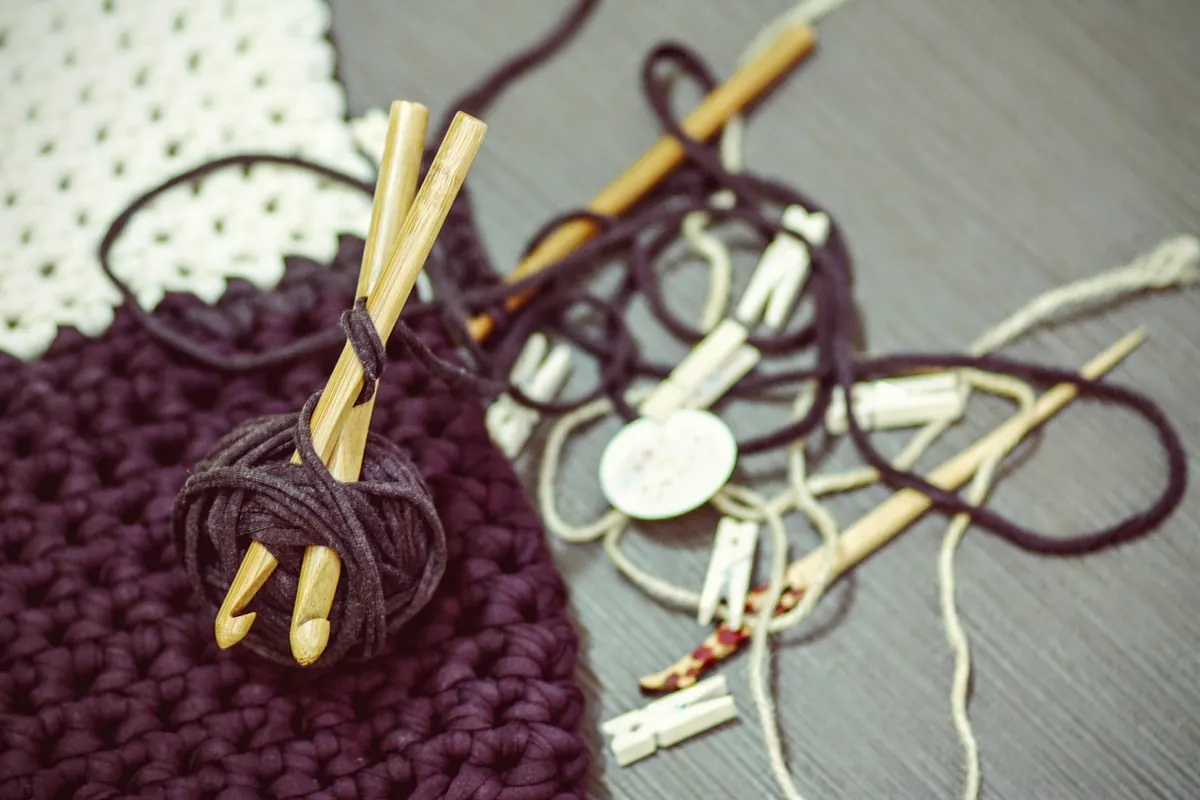
Photo: Engin_Akyurt / Pixabay
Summer Crochet: Lightweight Yarn Choices for Breathable Tops and Bags
A practical guide to choosing cotton, linen and summer blend yarns for crocheted tops and bags, with notes...
Local Italian Mill Yarn: Why Small-Batch Wool Offers Unique Texture and Color
Small-batch yarn from Italian mills behaves differently from mass-market skeins: how texture and colour...
About Us